28 November 2011

Concept of Gameplay mechanics_Rope Gun in action

Gameplay concept showing rope gun in use. Slide down to see.


Merde !


After five seconds guard player may stand up and continue his chase, If he knows which way to go.

Concept Art- Yakuza Rope Gun

Rope gun it one of the non lethal weapons-gadgets used by the burglars to stop or slow down chasing them guards. This gadget finds its way to the party in beautiful hands of yakuza girl. Design of this item resembles the look of a handle of Japanese sword. Item is made out of metal and it is covered by elements of leather or laka. Device can be easily and quckly installed in doors where it shoots out two ropes ending with arrow bolts. Rope gun can be used only once in emergency situation. Once set creates immidiate risk of tripping and contusion for rapidly approaching (and clumsy :P)enemies.

To be or not to be- YAKUZA

This is concept for one of the burglars called the yakuza girl. Yakuza brings the rope gun artifact to the game, therefore she was supposed to be one of the most important characters in the game. My initial thought about this character was "simplicity". When we think about design in Japan we probably imagine white paper walls, simple and elegant forms, mixture of black and white etc. I wanted this character to reflect all this. Her outfit is simple but elegant, with delicate white ad dons. Her dress is short in order to allow fast movement, and perhabs soe acrobatic stunts. The only element giving away her roots and profession was supposed to be dragon tattoo. But the problem is there may be no asian characters in the final game, therefore this character's development is temporarily put on hold.


Adding the mechanics to the block out

Today I began to add the mechanics to the level block out ready to show for the pitch.

Setting a tripwire

The Kismet may be more complex than I first thought...

26 November 2011

Stun mechanic

we did not want our weapons to kill the enemy players. What we required them to do instead was to stun them for a few seconds.

I struggled to work out a method of creating this effect without getting too code heavy (far too complex a sequence for my current knowledge of UScript) so instead I tried to do it in Kismet.

Early tests didn't seem to work with the 'TakeDamage' node not giving any results.

Instead I decided to try what I had used before, comparing Intgers.

This time I had a set value of health I wanted it to compare. This meant that by constantly checking the player's health the game could react if it fell below the default of 100. This would then trigger a different response.


I am concerned however on the drain this will have on a network game. I have asked on the Epic games forums if they could suggest a suitable loop value, but have of yet, not had a response.

25 November 2011

Flash-Light

The flash-light mechanic is a simple little mechanic that only security guards will have access to. Whenever a guard goes into a dark area, they will automatically get out a torch to see where they are going, whereas burglars have better sight in the dark and so don't require this feature.

24 November 2011

Usage Timer

While discussing the game, we stumbled across a missing but largely required mini mechanic; a usage timer.

This timer would be set off when any player does anything that requires a waiting time in the game. For example, when the burglar is cracking a safe open or picking a lock, it will show how long until you are done and have control over the character again. A guard would have it for arresting, or when they get stunned, etc, etc.

For each type of object and each instance, a different appropriate icon will appear in the middle of the timer.

Lighting - Team Specific Differences

With our new understanding of how we can control parts of the game to work only for certain teams in team-death-match mode, I began to look into a mechanic whereby the guard players would have to use a flash-light to see in dark rooms, while the cat burglar would have better eyesight, and can see in the dark far better.

The initial way of doing this was to create a light room, and a dark room, and place two Post Process volumes in the dark room; one for the guard to see through, and one for the burglar to see through. Despite this working there were some major problems, primarily with what the guards could see in terms of light from the other room.

To advance from this, I tried to make the room very dark from natural causes, not post processing. However, a downside to this is that Sky-Lights cannot be used in map lighting because they can light shadows, meaning even the darkest rooms would be lit somewhat.

So to make completely dark rooms, we have to block the windows (with curtains in game), and also tell the walls, floor and ceiling in that room only, to not emit any diffusion or emissive light, stopping the room lighting itself using indirect lighting methods from the light in the room next to it, or outside.
This is the lit room, using 1 spotlight facing the floor from the ceiling. You can see that the rest of the room is lit well from emissive, indirect light.
This room has had all surfaces told not to emit emissive light, however they do still accept it otherwise by the door the sudden falloff of light looked odd. This is what the guards would see in the dark room, which has no post processing at all.
Using a post process volume in the same dark room, this is what the burglars would see. It is lit-up with a blue tint. As much as this sort of works, there are problems, some of which I encountered before.
• The deep shadows of the room have been forced to light up, and that is causing us to see bad texture compression artefacts as a result.
• The doorway with its natural light from the other room has changed colour. When I forced the room to be dark using only post processing, this effect was even worse, but a better, more controllable look in the darkness overall.

Another reason why using post processing to simulate darkness was bad was because we wanted the guards to use a torch to see in the dark. However, with the post processing volume there too, the light would come out tinted blue also, not yellow.

Further research into possible ways is currently under-way.


Team specific triggers

One of the most important mechanics we needed for our gameplay to work was the ability to determine what team a player was on and change the output of triggers accordingly. We don't want, for example, the Burglar to be able to fall into his own trap, also we would not want the Guards to be able to lay the traps.

A kismet node that gets the team number was used in a sequence. It outputs an Integer which is then compared with a set value. The output then is split depending on which team presses the trigger.


This now allows us to begin to place the mechanics into our block-out. ready for the pitch.

Melee Weapon

Our game does not involve guns, instead all the fighting happens with guard batons and various objects around the level such as glass bottles.

Bringing in a simple melee weapon was a fairly simple affair following this guide UDKC Melee Weapon

For my test, I have set the weapon to do 100 damage, killing the enemy straight away.

We may run into issues regarding animation as most melee weapon animations seem to use the taunt animations which would mean that even if no weapon was in the characters hands, it would still play the animation. This is not desirable for our burglar, who spends most of their time without a weapon.

It will do for now.

New map-concept


While changing the layout of Villa Rose we came up with the idea of how to present its map in a game. An old map was supposed to be torn out of some documents kept in the villa.


The new map is basically whole document stolen from the security room in the house.


Map would be kept in burglar's pocket or a bag, then taken out and unfolded when necessary.


The design of the new map besides its obvious practical function was supposed to resemble some custom made old document with slightly yellow paper and signs of usage.


Name of the building has also been changed from Villa Rose to Chateau Rose, due to significant enlargement of form of the building.


Concepts of main characters- Brigitte

Brigitte is a French girl, member of the cat burglars. Difficult childhood in poor district of Paris, conflicts with parents and school principals, forced her to start new life away from home. As a teenager she started to steal food at the market. One day she was caught and locked at the local police station. Luckily her attempt to steal something to eat had been noticed by local crime boss who bought her out of jail and gave her proper training. From that time Brigitte works for him as a burglar. Do not be fooled by her nice face and faint figure. She knows plenty of tricks and techniques that will force every man down on his knees.

We wanted this character to be typical pretty French girl. Most probably brunette with shorter hair. Because the style of our game aims in realism, we needed real life references to support the design.


Here are some of the references ve have gathered.

The most accourate for our needs seemed to be photos of Marion Cotillard. (Bottom right).


First concept sketches included haircut options.


Next stage was sketching of our character's face.Our choice was at the bottom right.


Next stage of the design consisted of making of full gray scale character with clothing options.

These are only 2 out of 6 option boards. Final look of this character is still uncertain. Further concept work may be necessary. Then the next stage of the developmnent will be: colour options, final painted render and reference boards for Maya.

23 November 2011

Stage 2

Further development of the new and improved block-out. This shows some of the upstairs which has been made slightly more complex for 4 players, as well as shows the adding in of the new balcony overlooking the dinning room, and the skylight above that.
The new block-out with the Maya model ghosted over it for scale and reference. Also the block-out has some block-people standing around outside here for a sense of scale of people in comparison.
The new overlooking balcony in the dinning room. We made sure that players could only see each other from one side of it to the other, and not just run around and get the straight away. The rooms on the sides will force guards to run through them in order to catch the burglar if the spot him from the other side.
We also have fixed the old issue we had whereby the foyer rooms were too small. They now extend one window back into the main house and the house has been widened and lengthened  to accommodate this change along with others.


22 November 2011

Redesign

After local play testing between the three of us and some friend play-testers, we found that our initial block-out was too small and not complex enough for the gameplay we had designed. We found that we were trying to fit the map into a building that was too small to begin with. We designed the house in a modular way, so changing it was a simple case of rescaling rooms by duplicating blocks of wall on our initial 3D visualization in Maya.
For the level to accommodate 4 players (1 burglar and 3 guards), we had to make sure the layout was significantly complex in order to allow for the burglar to have a chance to escape.
Initial Design (Ground Floor)

New Design (Ground Floor)

We found the new concept to be significantly improved, enlarging appropriate rooms,  shrinking others and repositioning many of them. 
New Design (Upstairs)

A large part of our old problem was that the upstairs was too simple and easy for guards to catch the burglar, and so this needed more room to expand, which we achieved by widening the entire house, and adding a few windows extra length too also. We also decided to add a new tactical vantage point of the balcony surrounding the downstairs dinning hall.
  

To do the new block-out, after learning for our old mistakes in making the last one along with our new and vastly improved map layout, we decided to not only work for a blue-prints map textured floor, but also use a more fully-made concept model from Maya for correct scale and more accurate positioning. A semi-transparent shader was applied to this so that we could see through it to the brush-work.

This far cleaner block-out was created entirely a lot more with the final product in mind this time round. Thus, we set scales for walls, doors, windows, and even making sure we followed some rule of how wide and long the walls should be to ensure static meshes created at a later date would fit perfectly to them.

18 November 2011

It's alive!!!

Bob Box is now working in engine. It took a little bit of investigating and checking out the UDN support pages but I managed to get Bob working. For now he is using the UDK default animations but these will change.


Bob celebrates his new lease of life

Adding Sockets

Creating a PhysAsset

He lives

... He dies

From here we can add our own animations and eventually add our finished meshes to the character.

Map and Environments 3

We are constantly looking for new methods to refine our workflow. Initial 3d model prepared earlier in Maya 2011 will have its use as reference both for our concept art and further level design.


Render of sea side of the house served as reference for creating more detailed visualization in photoshop, including lights, textures and extra elements of decoration.

Will found a great example of the type of lighting we wanted for our level.


This work is still in progress. We may find some elements of the environment unnecessary, change, add or pelace something.

15 November 2011

Block-Out

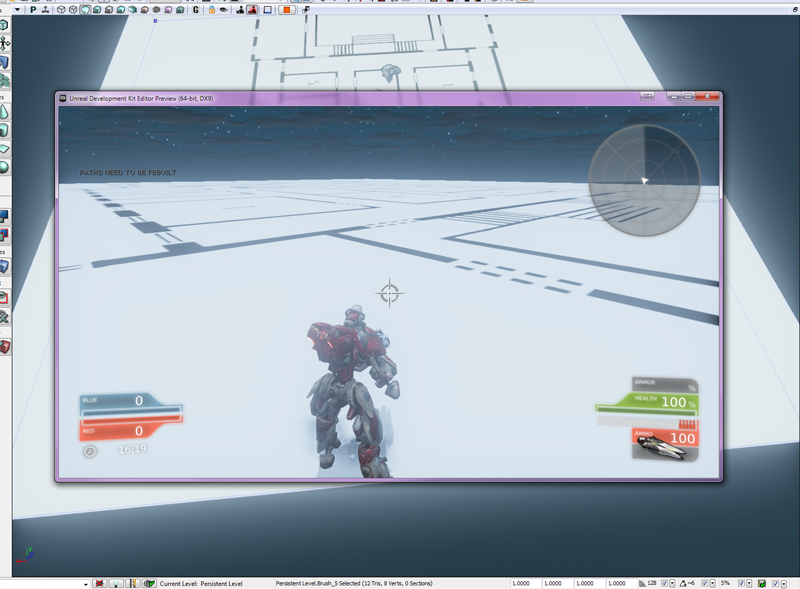
Using our floor-plan layouts that we designed, along with the knowledge that we have some of our game mechanics working at least to a representable standard, we decided it was time to begin the initial block-out of the level in which the demo will be set; Villa Rouge in the south of France.

To do this I first made a flat square BSP floor, and applied a map material to it using the downstairs map seen above. The three of us sat together and scaled and re-scaled it until it looked right when running around on it in game imagining there were walls and doors and so on.
The next stage was to build the map using BSP only at this point. Eventually, all BSP walls and interior would be replaced with static mesh walls that will be repeated all over and made to a high quality.

Once we had the lower floor, through further scale testing we decided to shrink the entire thing some more, which then required a re-build to snap to grid properly again, and stick to some kind of rule as to how thick each wall is, how wide each door is, and so on.
For this, a new texture was created. Because we were using the grid on the walls for height reference, we wanted to keep them.
Next I made the upstairs once we had re-snapped the downstairs to the grid at its new sizes, and populated it a bit more. Next I will be adding the attic and rooftops, as well as finishing off the rendering outside the building, and adding the garden.